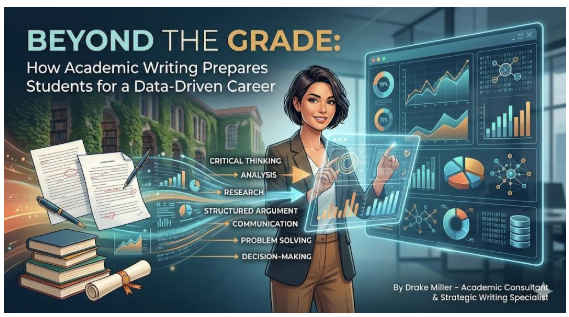
By Drake Miller – Academic Consultant & Strategic Writing Specialist
In the competitive landscape of the 2026 job market, “Big Data” is no longer just a buzzword for Silicon Valley tech giants. From healthcare systems in New York to environmental startups in Austin, the ability to make decisions based on evidence rather than “gut feeling” is the ultimate professional currency.
As an academic consultant, I often hear students ask, “Why do I need to write a 10-page thesis for a career in business or medicine?” The answer is simpler than you think: The process of academic writing is the most sophisticated training ground for Data-Driven Decision-Making (DDDM)—the number one skill sought by modern employers.
Whether you are a high school senior tackling a capstone project or a college junior preparing a complex thesis, mastering the art of the essay isn’t just about an “A” grade. It is about developing the cognitive architecture of a leader.
1. The Art of “Data” Collection: Information Literacy
In the corporate world, a data-driven decision is only as good as the data itself. If the input is flawed, the decision will be catastrophic. In academia, we call this the “Research” phase.
For a student, a research paper requires navigating complex databases like JSTOR, PubMed, or EBSCO, evaluating source credibility, and differentiating between peer-reviewed evidence and biased opinions. This “Information Literacy” is the exact same skill used by a Market Research Manager. Before a multi-million dollar product launch, they must filter through market trends and consumer metrics. By learning to curate high-quality academic sources, students develop a “mental filter” for accuracy—a prerequisite for any data-driven leader.
2. Moving Beyond Observation to Deep Analytical Interpretation
Data-driven decision-making isn’t just about having data; it’s about interpreting it. Raw data is just noise until a human mind provides context. Academic writing forces students to move past the “what” (description) and into the “why” and “how” (analysis).
Whether you are analyzing a character’s motives in a literature essay or interpreting the results of a chemistry experiment, you are practicing the “analysis” phase of DDDM. For students who find themselves overwhelmed by these complex requirements, utilizing professional research writing guides can provide a vital roadmap. Observing how an expert structures an argument helps students understand how to bridge the gap between raw research and a persuasive, evidence-based conclusion.
3. Structuring a Narrative: The Power of the “Data Story”
A data scientist can have the most accurate charts in the world, but if they cannot communicate the “So what?” to the board of directors, the data is useless. In the USA, communication skills are often cited by employers as the #1 gap in new hires.
Academic writing teaches the Claim-Evidence-Warrant model, which is the gold standard for business persuasion. Part of this professional communication involves high-level organization and technical accuracy in citation. Understanding the nuances of your presentation—such as the structural differences in endnotes vs footnotes — ensures that your “data story” remains professional, navigable, and credible to your stakeholders.
See also: Website Traffic 6175253556 With Technical Audit
4. Objective Synthesis: Eliminating Cognitive Bias
One of the greatest hurdles in modern decision-making is Confirmation Bias—the human tendency to favor information that confirms our pre-existing beliefs. In a data-driven environment, bias is a liability.
Academic writing demands objectivity through the “Literature Review” and “Counter-Argument” sections. To write a successful paper, a student must acknowledge opposing viewpoints and use data to either refute them or—more importantly—integrate them into a more nuanced conclusion. This process trains the brain to remain neutral and follow where the evidence leads. In a future boardroom, this translates to a leader who is willing to pivot their strategy when the data shows their initial plan is failing.
5. The Iterative Process: Data Cleaning and the Revision Loop
In data science, “cleaning” the data—removing errors and refining the set—is often the most time-consuming task. In the world of writing, we call this Revision and Editing.
The revision process teaches students an invaluable lesson: the first “set of results” (the first draft) is rarely the final answer. This iterative mindset—Hypothesize, Test, Analyze, Refine—is the “Agile” framework used by tech companies worldwide. A student who meticulously proofreads their work is practicing the same attention to detail required of a software engineer debugging code or a financial analyst checking a budget forecast.
Why This Matters for the Future of US Education
As Artificial Intelligence (AI) continues to handle the “crunching” of numbers and the basic retrieval of facts, the human element of decision-making becomes significantly more valuable. Employers are no longer looking for “human calculators”; they want synthesizers.
By treating every academic assignment as an exercise in data-driven logic, students across the USA are preparing themselves for the high-stakes environments of the 21st century. Whether you are aiming for a career in law, medicine, or entrepreneurship, your ability to write is your ability to think.
Frequently Asked Questions
Q.1 Why is academic writing still important if I have AI tools?
While AI can generate text, it lacks the strategic synthesis and ethical judgment required for high-stakes decisions. Writing your own papers trains the “human-in-the-loop” skills necessary to manage AI effectively in your future career.
Q.2 How can students improve their writing logic effectively?
Mentorship is key. Many students use structured academic writing support from Myassignmenthelp to see how professional researchers connect evidence to logic. These serves as a blueprint for developing your own voice and analytical style.
Q.3 What is the most important skill for a data-driven career?
Objectivity. Academic writing is the only discipline that forces you to argue against your own bias, a skill that is vital when analyzing market trends or scientific data.
Final Thoughts: Mastering the Craft
Next time you sit down to write an essay, don’t view it as a hurdle. View it as a simulation for a future boardroom meeting. You are collecting data, analyzing trends, removing bias, and presenting a winning strategy. These aren’t just “writing skills”—they are the blueprints for the leaders of tomorrow.
If you ever feel that the technicalities of these assignments are hindering your ability to learn the logic behind them, remember that resources are available to help you master the craft. Whether you need to learn the basics or want to see how the pros do it, the goal remains the same: becoming a sharper, more analytical thinker for the world that awaits you after graduation.
Author Bio
Drake Miller is a veteran academic consultant with over 10 years of experience helping US students bridge the gap between classroom theory and professional practice. He specializes in strategic communication and helps students transform their academic struggles into career-defining strengths.


 By
By